Hindi is the Primary Official Language of the Republic of India. It belongs to Indo-Aryan Language Family. It is a Standardised and Sanskritised Register (a variety of a language used for a particular purpose or in a particular social setting) of the Hindustani Language. It is amongst the 22 Official Languages of India. Hindi is the official language of Arunachal Pradesh, Bihar, Jharkhand, Uttarakhand, Madhya Pradesh, Rajasthan, Uttar Pradesh, Chhattisgarh, Himachal Pradesh, Haryana, and Delhi. Hindi is accorded the status of co-official language in certain states. Hindi is closely related to Urdu, which has also been derived from the Khari Boli Dialect. It is also known as Standard Hindi, Modern Standard Hindi, Manak Hindi, High Hindi, Nagari Hindi and Literary Hindi. Modern Hindi is mutually intelligible with the alternative register of the Urdu language. As per 2011 estimates of Ethnologue there are 550 million speakers of Hindi. Ethnologue is a web and print publication of SIL International, a Christian linguistic service organization, which studies lesser-known languages, primarily to provide the speakers with Bibles in their native language. But the number of native speakers of Standard Hindi is uncertain. As per the 2001 Indian census, 258 million people in India consider their native language to be ‘Hindi’, i.e. 41% of the Indian population speaks Hindi as its First language and more than 70% Indians can understand and speak Hindi to a certain level. Hindi is the lingua franca in many non-Hindi speaker states, such as the north eastern Indian state of Arunachal Pradesh, and is second most spoken language after Bengali in Andaman Islands and north eastern states. It is to be noted that this figure includes large numbers of speakers of Hindi dialects besides Standard Hindi. Hindi is also understood and spoken in Nepal, Bangladesh, Pakistan, some areas the Fiji, Guyana, Mauritius, Suriname, Trinidad and Tobago, Western Europe, South Africa, USA etc.
Varieties or Dialects of Hindi
There is no fixed number Hindi Language Dialects, however as per Census of India 2001, there are 49 dialects of Hindi.
|
Some of the Hindi Language Dialects |
|||
|
Dialect |
Region |
Dialect |
Region |
|
1. Haryanvi |
Haryana |
11. Garhwali |
Uttaranchal |
|
2. Surgujiya |
Chhattisgarh |
12. Kumaoni |
Uttaranchal |
|
3. Chhattisgarhi |
Chhattisgarh |
13. Marwari / Merwari |
Rajasthan, Haryana some parts of Gujarat. |
|
4. Awadhi |
Uttar Pradesh |
14. Lambadi |
Maharashtra, Karnataka, Andhra Pradesh |
|
5. Bhojpuri |
Uttar Pradesh |
15. Harauti |
Rajasthan |
|
6. Kanauji |
Uttar Pradesh |
16. Godwari |
Rajasthan |
|
7. Bagheli |
Madhya Pradesh |
17. Bagri |
Rajasthan |
|
8. Malvi |
Madhya Pradesh |
18. Magadhi / Magahi |
Bihar |
|
9. Kangri |
Himachal Pradesh. |
19. Pahari |
Himachal Pradesh, Punjab, Jammu & Kashmir, Sikkim, West Bengal, Nepal, Pakistan, Tibet |
|
10. Bundeli |
Madhya Pradesh |
20. Mewati |
Mewat region of Haryana, Rajasthan and Pakistan; Punjab and Sindh |
Origin and History
The language acquired its current form over many centuries. Hindi has been derived from the Khariboli dialect of Delhi and the surrounding western Uttar Pradesh and southern Uttarakhand region. Hindi first started to be used in writing during the 4th century AD. It was originally written with the Brahmi script but since the 11th century AD it has been written with the DevanÄgarÄ« alphabet. Hindi and Urdu descended from Hindustani which was a form of speech spoken in and around Delhi in North India during 9th and 10th centuries. It was termed as Hindvi/Hindi, a Persian name given by Persian-speaking Turks who ruled Punjab and the Gangetic plains in the early 11th century. Hindvi/Hindi means the ‘Language of Hind’, the land of the Indus River. Hindvi was largely based on Sanskrit words that had been adjusted for common speech. Hindi was also influenced by Persian and Arabic languages. These additions developed a mixed or a broken language of communication between the newly arrived immigrants and the resident native population of North India. From there, it spread to south and west as the Sultanate (persian kingdom) expanded beyond the Gangetic plains.
Modern standard Hindi further evolved from the interaction of early speakers of Khari Boli with Muslim invaders from Afghanistan, Turkey, Central Asia and other regions. Because of its association with Persian and Arabic languages, Hindi has a special relationship with Urdu. Their grammar and much of their vocabulary are virtually identical. Spoken Hindi and Urdu were known as one as the same language; termed as Hindustani. The first printed book in Hindi was John Gilchrist's Grammar of the Hindoostanee Language which was published in 1796. Hindi developed into a national language during the colonial period when the British colonisers wanted a standard language among government officials. From the 18th century Hind was widely used for literary purposes in the form of poems and proses.
During the independence of India in 1947, Hindi and Urdu separated to form their respective languages. Hindi acquired a Sanskrit bias and Urdu acquired a Persian bias. Hindi became to be written in the Devanagari script while Urdu came to be written in the Perso-Arabic script. Various grammatical changes took place with the passage of time. Earlier, the ‘Relative Clause’ was placed either at the beginning or at the end of the ‘Main Clause’. For example - the sentence - ‘The man who came here yesterday is my friend’ in several ways, like - “Wo aadmi mera dost hai jo kal yahan aaya tha” and so on After colonization, Hindi syntax was influenced by partially by English, until the mid-19th century, Hindi had no form for Indirect Narration – previously one could say – Harish said “I won’t dance” – ‘Harish ne kaha, mein nahin nachoonga’ and now one can also say “Harish said that he won’t dance” – ‘Harish ne kaha ki wo nahin nachegaa’.
In 1950, the Constitution of India was adopted and it declared ‘Hindi in the Devanagari script as the official language (rÄjabhÄá¹£Ä) of the Union (Article 343(1). Hindi is also enumerated as one of the 22 languages of the Eighth Schedule of the Constitution of India, which entitles it to representation on the Official Language Commission. The Constitution of India has stipulated the usage of Hindi and English to be the two languages of communication for the Central Government.
After independence, the Government of India set about standardizing Hindi as a separate language from Urdu, instituting the following conventions:
Standardization of Grammar: In 1954, the Government of India set up a committee to prepare a grammar of Hindi; The committee's report was released in 1958 as "A Basic Grammar of Modern Hindi".
Standardization of the Orthography: Using the Devanagari script, the Central Hindi Directorate of the Ministry of Education and Culture brought about uniformity in writing, to improve the shape of some Devanagari characters, and introducing diacritics to express sounds from other languages.
Standardization of Vocabulary – It was done by replacing most of the more learned Persian loan words with new coinages from Sanskrit.
Scientific mode of scribing the Devanagari alphabet.
Incorporation of diacritics in to express sounds from other languages.
Hindi became the official language of India on January 26, 1965, although English and 21 other languages are recognised as official languages by the Constitution of India.
Orthography
Literary Hindi, written in the Devanagari script, has been strongly influenced by Sanskrit.
Sanskrit and the Prakrit and Apabhramsha languages. the precursors of Hindi, influenced by Persian. the difference being that Hindi is written in Devanagari and draws vocabulary from Sanskrit, while Urdu is written in Persian script and draws on Persian and Arabic.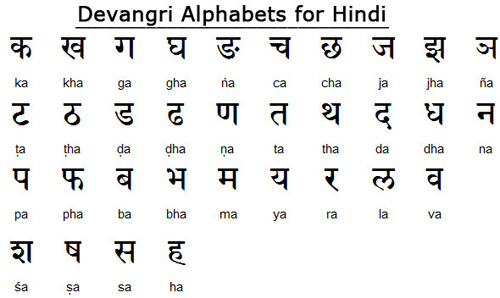
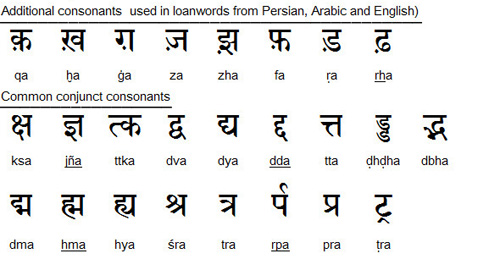
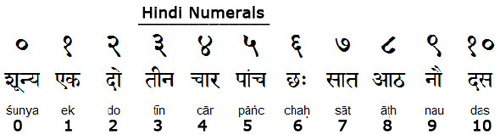
Some Persian Words used in Hindi
Abad - Inhabited
Abadi – Population
Bahi - Account Book
Chador – Bedsheet.
Dalil – Argument
Divar – Wall
Faujdari - Criminal Case
Faisla – Judgment
Gavahi – Witness
Hina - Henna
Mez - Table
Musahib - Courtier
Sabun - Soap
Kursi – Chair
Vazir – Minister